Relive: Novel Design Approaches to Livingnes

Edited by Venere Ferraro and Giorgia Burzio

The image is an abstract graphic background featuring a dark forest green gradient. The composition continues the visual language of the previous series, showcasing minimalist and blurred overlapping geometric shapes. Specifically, two large blurred circular forms are visible at the bottom, while a stylized radial shape, resembling a star or a sun, emerges from the top of the frame. The style is clean, elegant, and professional, ideal for presentations or digital interfaces.

The new volume in the Design International series explores new design approaches to integrating the concept of 'livingness' into design artefacts and systems.

Relive: Novel Design Approaches to Livingness, explores novel design approaches for integrating the concept of 'livingness' into artefacts and design systems. The book compiles the findings of the RELIVE research project, which was financed by FARB (research funds of Politecnico di Milano) and developed within the Design Department at the Politecnico di Milano.

The theme of 'livingness' — that is, the quality of living and the incorporation of living materials and systems in design processes, is explored adopting an interdisciplinary approach that It involves design, biology, and human-computer interaction (HCI). The aim is to propose new theoretical and operational perspectives for designing of living artefacts that can interact with the environment and users logic of mutual regeneration and care.
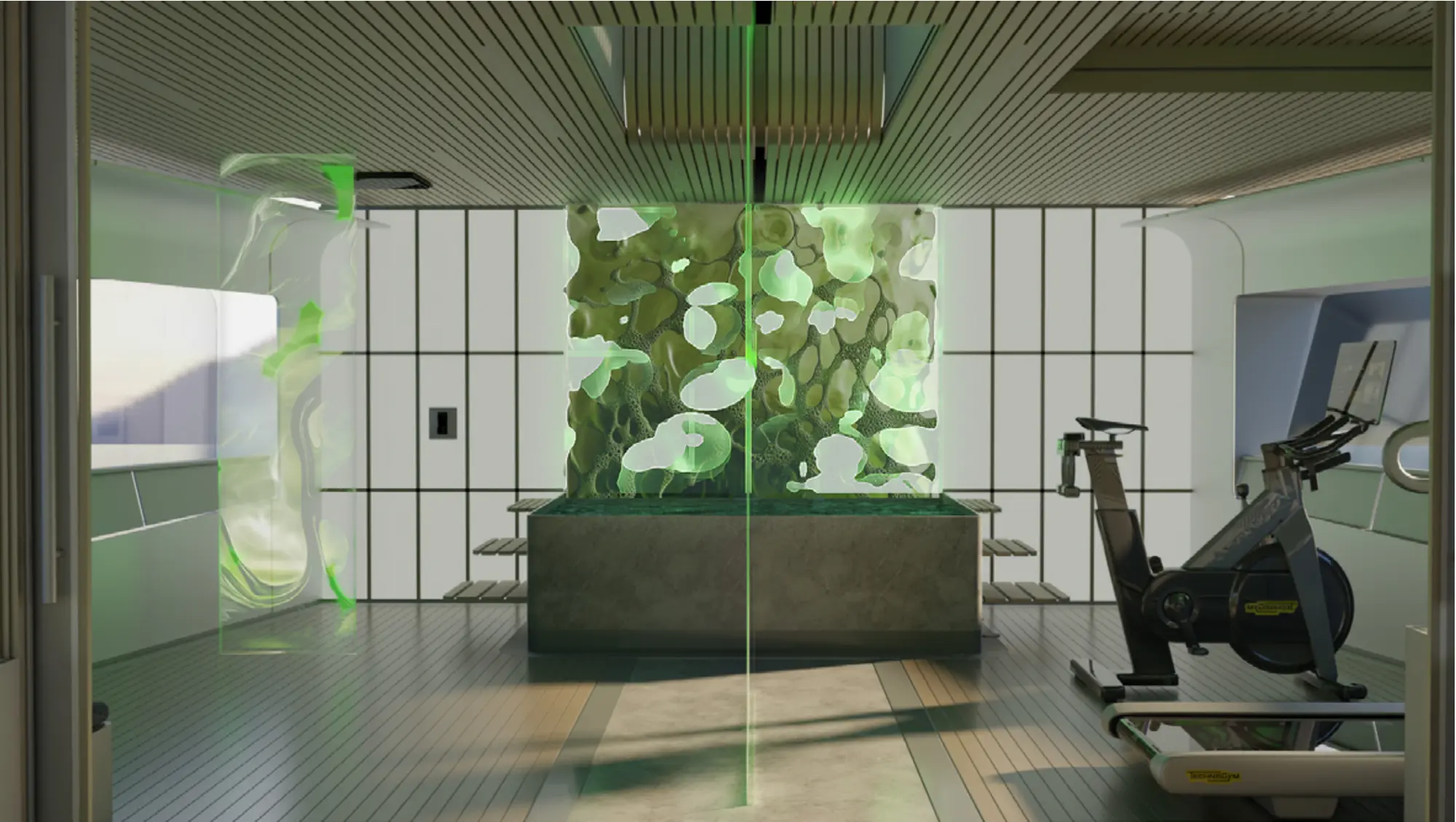
The image shows an architectural rendering of a luxury gym interior on board a superyacht. The space is centered around a large bioplastic installation that evokes illuminated green organic forms, set above a natural stone base. Technogym equipment is positioned on the right, including an interactive stationary bike and a treadmill, while on the left, a green translucent panel serves as a divider and full-height mirror. Slatted wooden floors and ceilings complete an atmosphere that blends high technology with biophilic design.
Spirulini – Blending Spirulina and Physarum polycephalum for bioregenerative wellness yacht interiors. Image taken from the essay 'Living materials for yacht design' by Nicla Guarino, Ludovico Ruggiero, Elena Albergati, Arianna Bionda.

Through case studies, bibliographic analyses and experimental activities, the book introduces a new definition of 'livingness' and suggests design approaches that incorporate living materials and digital technologies. Of particular relevance is the account of the experiments conducted in three design workshops, two of which were hosted by the School of Design at the Politecnico di Milano, and one held in an international context. These explored concrete applications in fashion, nautical design, health, and biological filtering systems.
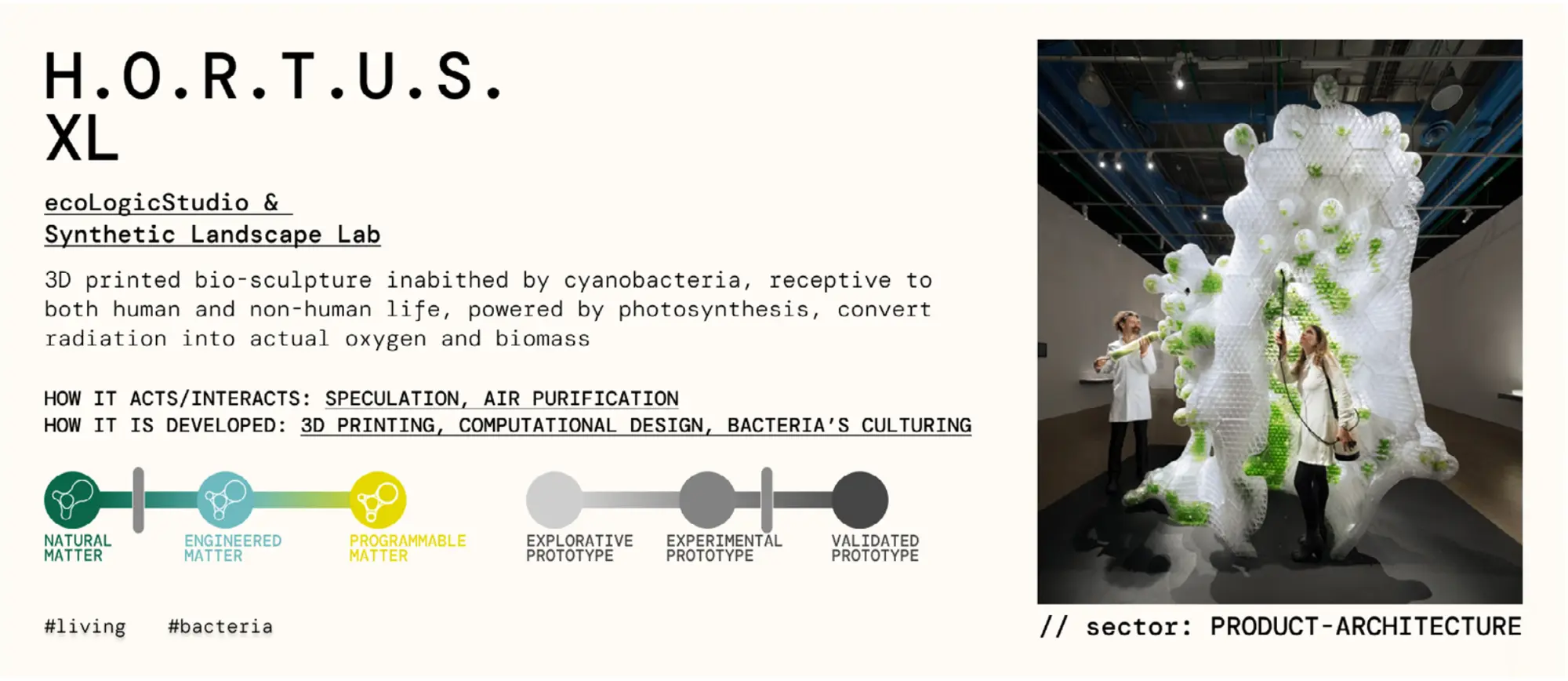
This collection of images documents a design and research ecosystem that blends participatory methodologies, material innovation, and interactive technologies. It begins by showcasing co-design sessions where participants use visual tools, such as proximity maps and photographic mood boards, to design community spaces and services. This is followed by a section dedicated to museum exhibitions, featuring sensory installations, experimental material samples protected by display cases, and interactive touch-tables for digital design. Finally, the "H.O.R.T.U.S. XL" project is presented—a 3D-printed bio-sculpture that integrates cyanobacteria for air purification, exemplifying the intersection of biotechnology, computational design, and sustainable architecture through a journey from natural to programmable matter.
Case study card of ecoLogicStudio & Synthetic Landscape Lab, H.O.R.T.U.S. XL. Image taken from the essay 'Exploring livingness through case study: an annotated portfolio' by Valeria Regis.

Relive:Novel Design Approaches to Livingness is a valuable resource for designers. Researchers and practitioners interested in exploring the potential of living artefacts and design practices that can activate regenerative futures, as well as new forms of relationships between humans and the environment. The book is available in the FrancoAngeli open access catalog.

Contributions: Annamaria Alabiso, Elena Albergati, Lucrezia Alessandroni, Arianna Bionda, Valerio Cantelmo, Giovanni Maria Conti, Fiammetta Costa, Nicla Guarino, Matteo Meraviglia, Luciana Migliore, Attilio Nebuloni, Valeria Regis, Ludovico Ruggiero.

Share on: