
Generative AI in the Design Process. A journey through image generation for concept ideation

By Agnese Azzola, Fabio Figoli and Lucia Rampino

The image is an abstract graphic background featuring a deep teal blue gradient. The composition displays minimalist, blurred overlapping geometric shapes: a soft circular form is visible at the bottom center, while two large radial icons resembling gears or stylized stars occupy the left side and the upper right corner. The style is clean, understated, and professional, maintaining perfect aesthetic continuity with the previously shown background series.

The book explores the use of generative AI in the early stages of industrial design ideation. Through research, experimentation, and case studies, it examines how AI can enhance creativity and human collaboration during concept development.

Generative AI in the Design Process. A journey through image generation for concept ideation by Agnese Azzola, Fabio Figoli e Lucia Rampino was published by FrancoAngeli.

This book presents the evolution of a master's thesis research conducted within the Master of Science in Design & Engineering at Politecnico di Milano. It explores the role of generative AI—particularly text-to-image tools like Midjourney—in the early stages of the product design process. The research aims to examine how these tools can support the conceptual phase of industrial design by fostering inspiration, accelerating ideation, and enabling new forms of creative collaboration.
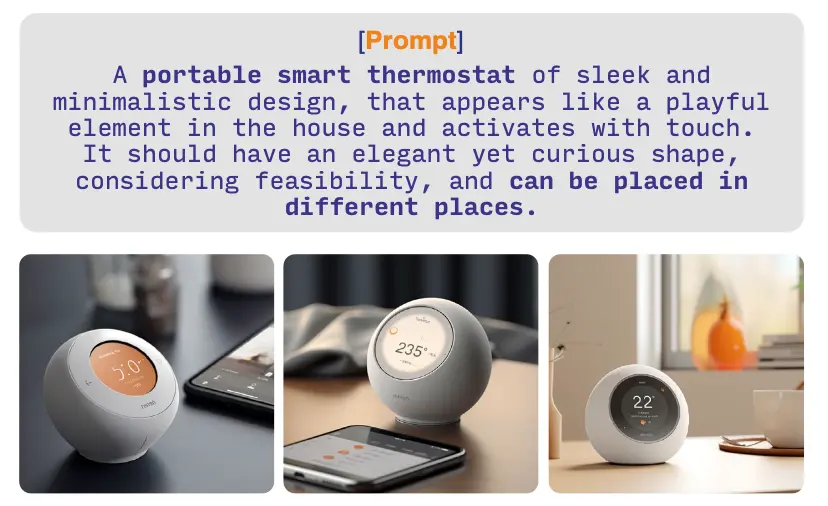
The image illustrates a product ideation process using generative AI. At the top, a text box defines the prompt for a portable smart thermostat with a minimal, playful, and elegant design that activates via touch. At the bottom, three photorealistic renders show different interpretations of the device: a matte white spherical object with an integrated circular digital interface. The images contextualize the object in modern home settings, displaying it alongside a smartphone for remote control or on a table near a cup, highlighting its compact size and sophisticated aesthetic.
Prompt for designing a thermostat.

Drawing from a literature review, observation of practitioners’ approaches, and hands-on experimentation, the book offers reflections on the evolving relationship between human creativity and algorithmic generation. It is structured in four parts and includes both theoretical insights and practical guidelines.

Through the creation and analysis of three AI-generated product concepts, the author investigates the need to translate visual outputs—primarily intended for creative expression—into meaningful and realistic design developments.

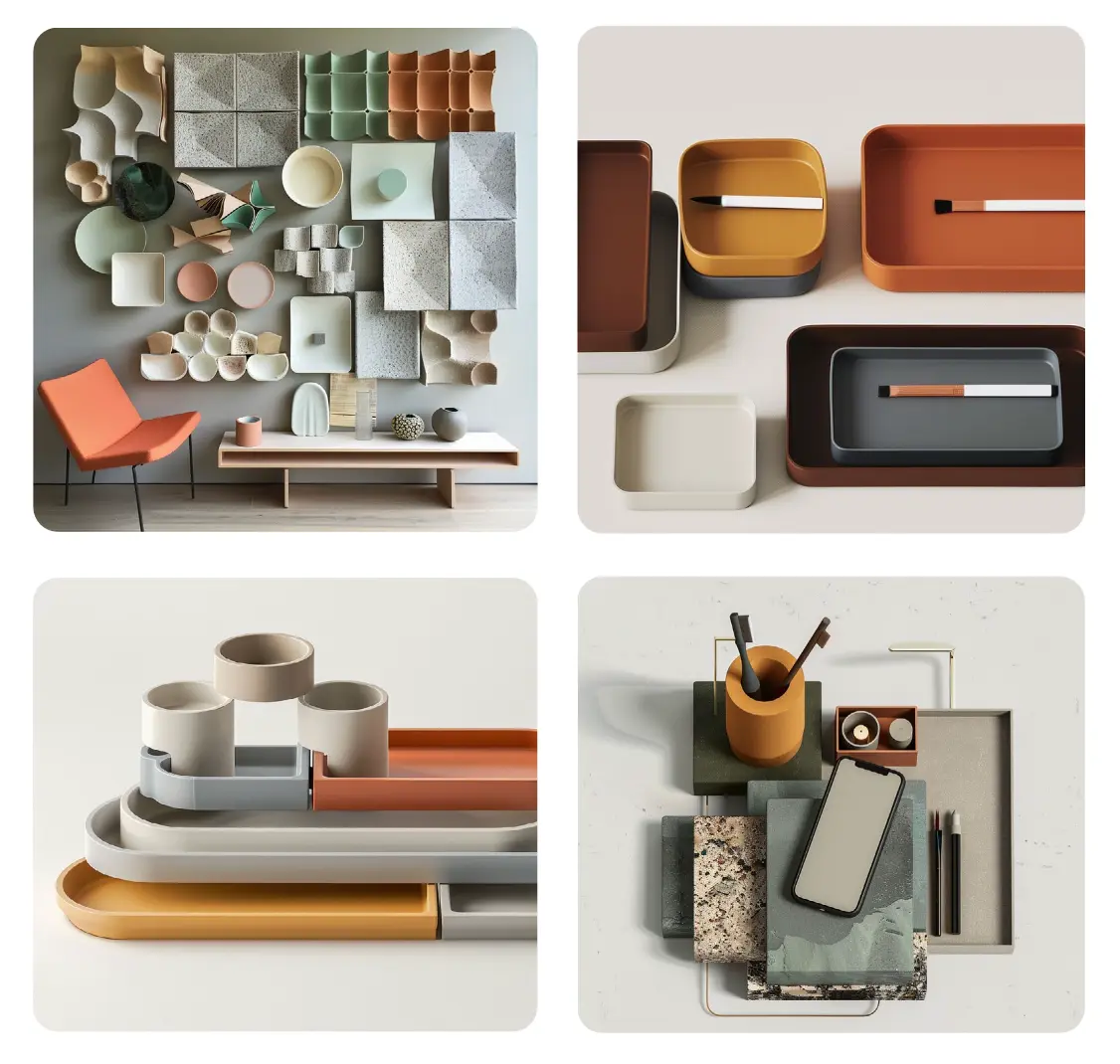
he images showcase a design ecosystem that ranges from conceptual research to industrial production and exhibition design. There are abstract graphic backgrounds with blue and purple gradients that evoke geometric shapes and mechanical elements, alternating with scenes of collaborative workshops where participants use proximity maps and material samples for spatial design. A section dedicated to product design illustrates luxury superyacht concepts and playful smart thermostats, alongside a series of office accessories characterized by minimalist forms and a warm, tactile color palette. The industrial dimension is represented by a specialized technician engaged in the maintenance of a large marine propeller, while the cultural aspect emerges through immersive museum installations featuring objects in display cases and digital interactive tables for visitor engagement.
Some absurd results, displaying nonsensical elements typical of AI generated imagery, that were not presented during the process.

The work proposes a design-oriented approach to applying AI-generated content within the design process, offering insights into human–AI collaboration. Intended for researchers, designers, and practitioners interested in integrating emerging AI technologies into design workflows, the book provides a timely snapshot of a rapidly evolving field, outlining key opportunities, challenges, and potential trajectories for future development in industrial design.

Generative AI in the Design Process. A journey through image generation for concept ideation is available in the FrancoAngeli open-access catalog.

Share on: