Unknown Unknowns: Triennale opens up to Design for Space

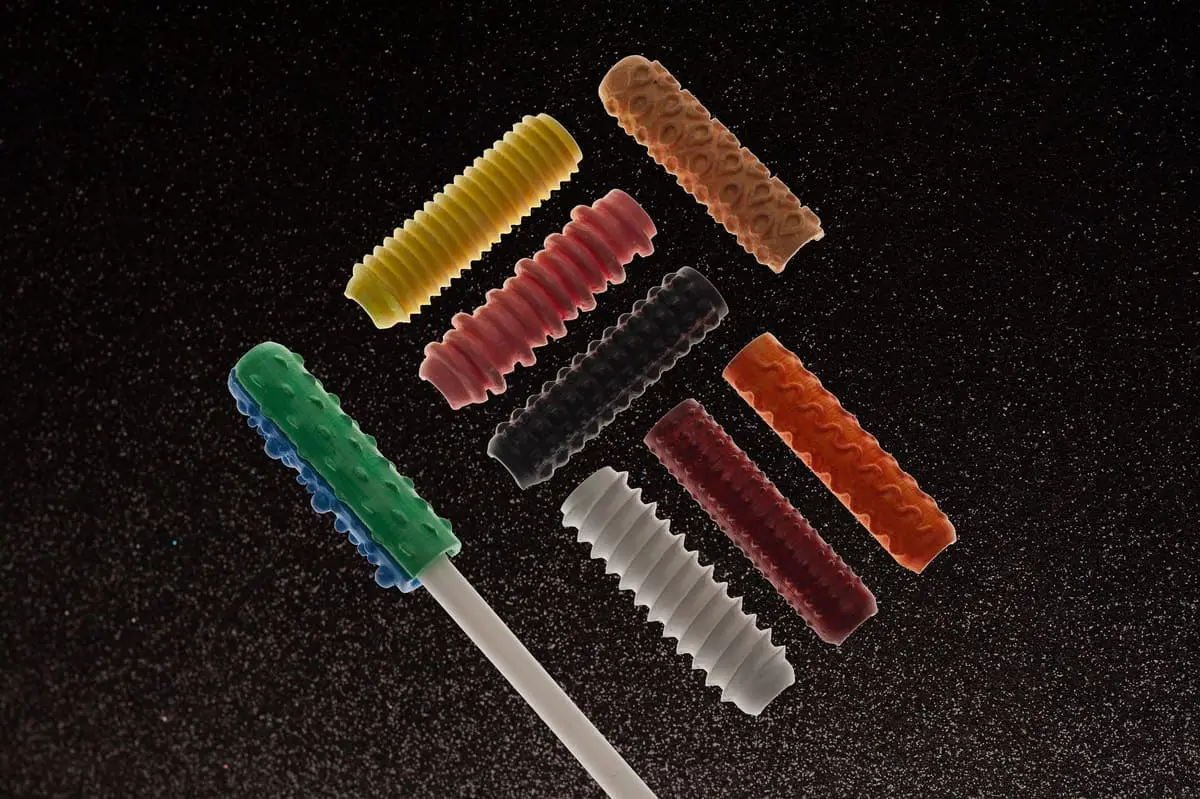
The image presents a chromatic and material exploration of modular components, displayed in a setting that evokes technological research in a space context. Against a dark, grainy background that suggests the surface of an asteroid or the cosmic vacuum, several textured cylinders are arranged. These elements, resembling interchangeable grips or sensors, feature a variety of finishes: from wavy and ribbed surfaces to dotted or honeycomb patterns. The color palette is diverse, including tones of yellow, pink, brown, orange, grey, and an intense green. In the lower left, one of these modules (green and blue) is mounted on a thin white stem, suggesting the system's modularity. The composition emphasizes the contrast between the vibrant colors of the components and the deep darkness of the background, evoking a catalog of personalized tools for future space pioneers.

The theme of Triennale Milano's 23rd international exhibition broadens our view of what we still don't know and explores frontier territories, such as Design for Space and life on other planets, the subject of cutting-edge research by the Space4InspirAction research and design laboratory of the Design Department, created and directed by Annalisa Dominoni and Benedetto Quaquaro.

From 15 July to 11 December 2022, the thematic exhibition Unknown Uknowns. An Introduction to Mysteries, which presents more than one hundred works, installations and projects by artists, architects, designers, physicists and researchers confronting the unknown, an opportunity to marvel at the vastness that eludes us. A section of the exhibition is dedicated to Space4InspirAction's space projects, developed from 2017 to the present and designed for a new environment governed by laws different from those we have on Earth.

The projects on display also include space objects, designed to live comfortably and sustainably in extra-terrestrial, confined and reduced-gravity environments, created by a group of young designers trained within the eponymous Space4InspirAction course, the first and only Space Design course in the world recognised and supported by the European Space Agency (ESA), within the Master's Degree in Integrated Product Design of the School of Design of the Politecnico di Milano.
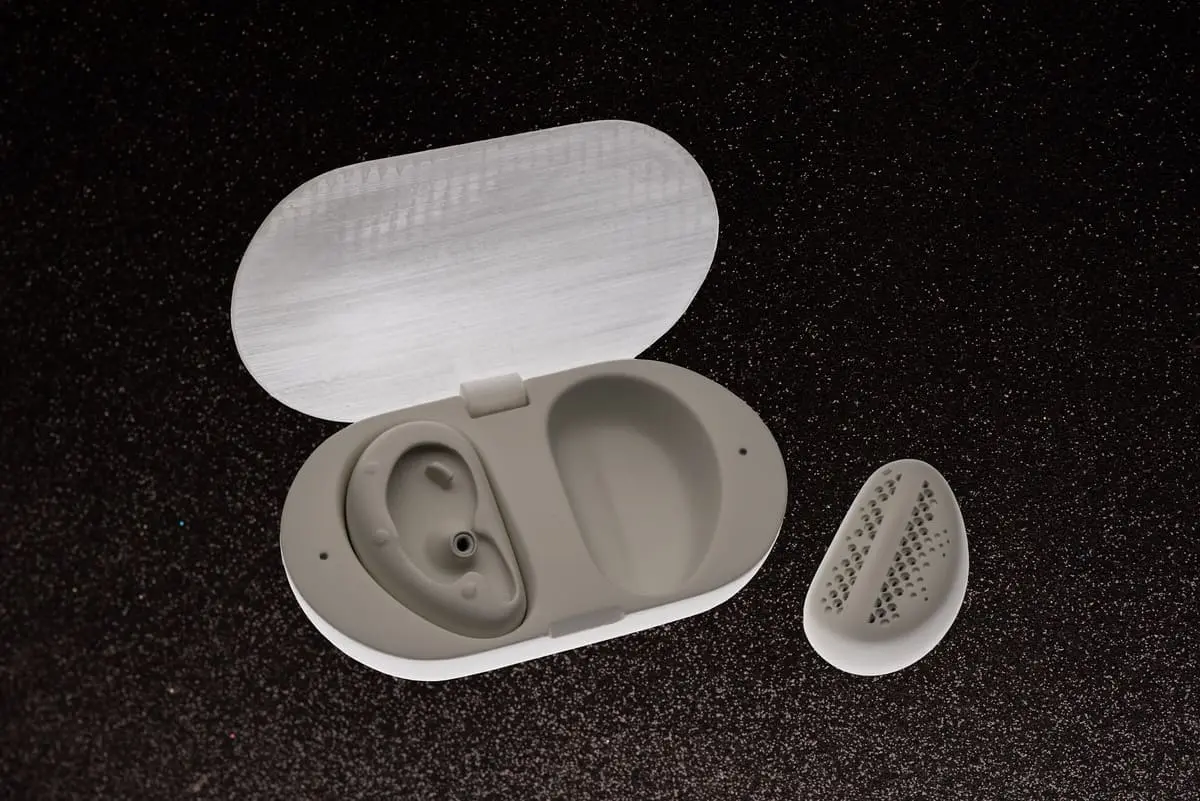
The image features a close-up view of a set of technological devices with a minimalist and futuristic design, presented against a grainy black background reminiscent of stardust or regolith. In the foreground, a white elliptical container with its lid open stands out, revealing two shaped slots inside. One of these houses a small device that faithfully reproduces the complex anatomy of a human ear, suggesting an application in the field of hearing aids or personalized communication systems. Next to the main container is a separate component, a sort of protective shell with a perforated honeycomb texture, typical of generative design. The clean aesthetic, neutral colors, and contrast with the dark background evoke a context of advanced biotechnology and space research, where technology is perfectly modeled on human biology.
**ONANZE:** Earphones to be worn like jewellery to reduce the frequency of noise on board the International Space Station thanks to the hexagonal texture. *Onanze* makes it possible to talk to family members on the ground and is able to reproduce natural earth sounds such as those of rain, streams or a forest, to balance the astronauts' stress levels that can be monitored non-invasively. On the soft surface of the earpiece in contact with the ear are 3 small spheres that correspond to specific reflexology points. Authors: L. Arboit, L. S. H. Ayazo, M. Kerdaffrec, D. Lin, L. Hongmiao

Designing for Space means "starting over", living in "another body" and in an unfamiliar environment that is not part of our everyday experience, where confinement and reduced gravity have a decisive impact on the way we perceive and react to new external stimuli.
In Space we experience disorientation and spatial transfiguration: the changing geometry of gravity draws a cognitive, postural and spatial shift, while the body undergoes strong physical, physiological, and sensory alterations, gravity can therefore be considered the greatest designer - to quote the words of curator Ersilia Vaudo Scarpetta, astrophysicist and Chief Diversity Officer of the European Space Agency (ESA) - that has a decisive influence on our lives and the behaviour we assume when moving in Space.

For these reasons, 'designing for Space' requires a great deal of use foresight to imagine how an object will behave in space, how it will be used, and how it will relate to its surroundings. This means that design plays a crucial role in creating new gestures and behaviours, both of humans and animated objects, in an unknown environment, outer space, which are altered by the absence of gravity.

«When we design for astronauts, - explain Annalisa Dominoni and Benedetto Quaquaro, - we try to immerse ourselves in the environment of the International Space Station (ISS) and imagine how our bodies could move in a confined space and in microgravity, how our postures and gestures could change in relation to objects, and above all, how new tools could be designed to function well in Space and, why not, take advantage of the lack of gravity, which has always been considered a limitation to be opposed.»

In the Space4InspirAction course, Professors Dominoni and Quaquaro teach students to develop a great capacity for vision, but also and above all for 'pre-vision': because how astronauts live, we on Earth can only imagine.
Designing in a hitherto unknown field such as space has led them to define a new methodology called Use and Gesture Design (UGD) which is based on the simultaneous design of environments, objects and gestures, transforming microgravity from a limitation into an advantage.

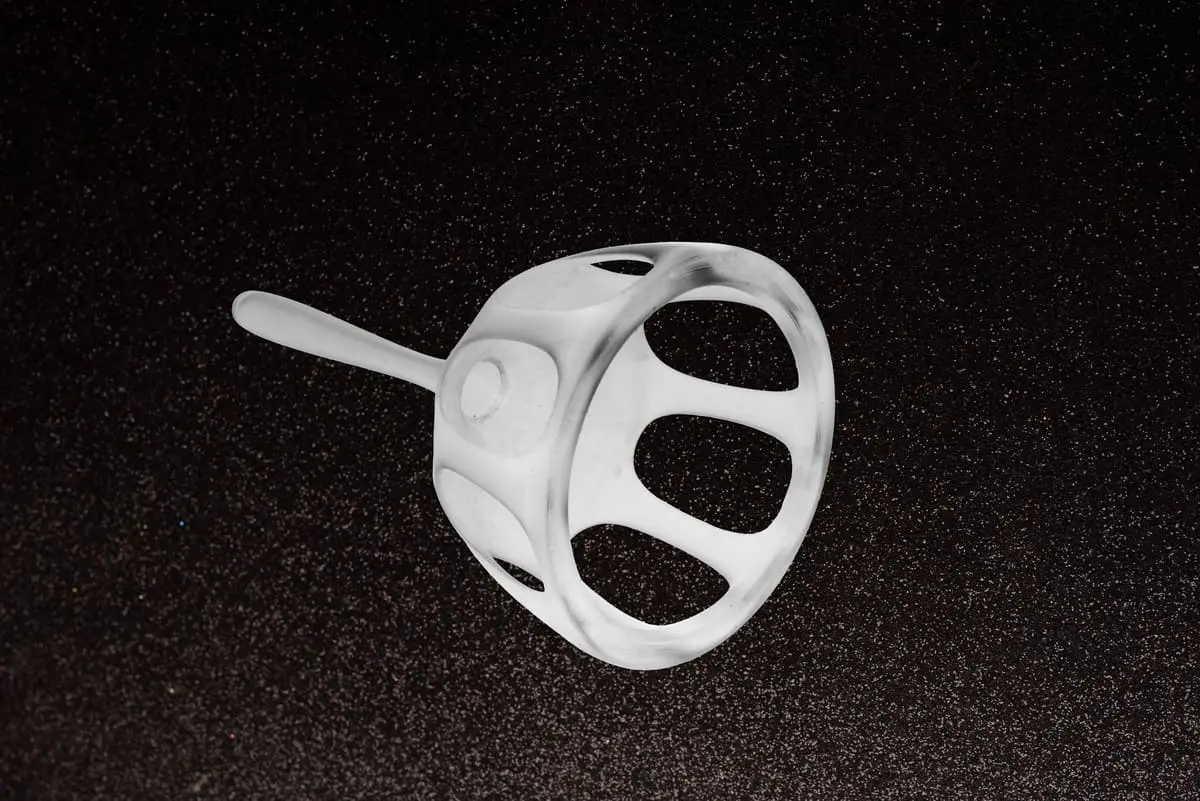
Among the examples of spatial design, in which design plays a central and strategic role, is Emo Space, a futuristic object that cooks food by shaking the ingredients inside, thanks to movement facilitated by weightlessness.

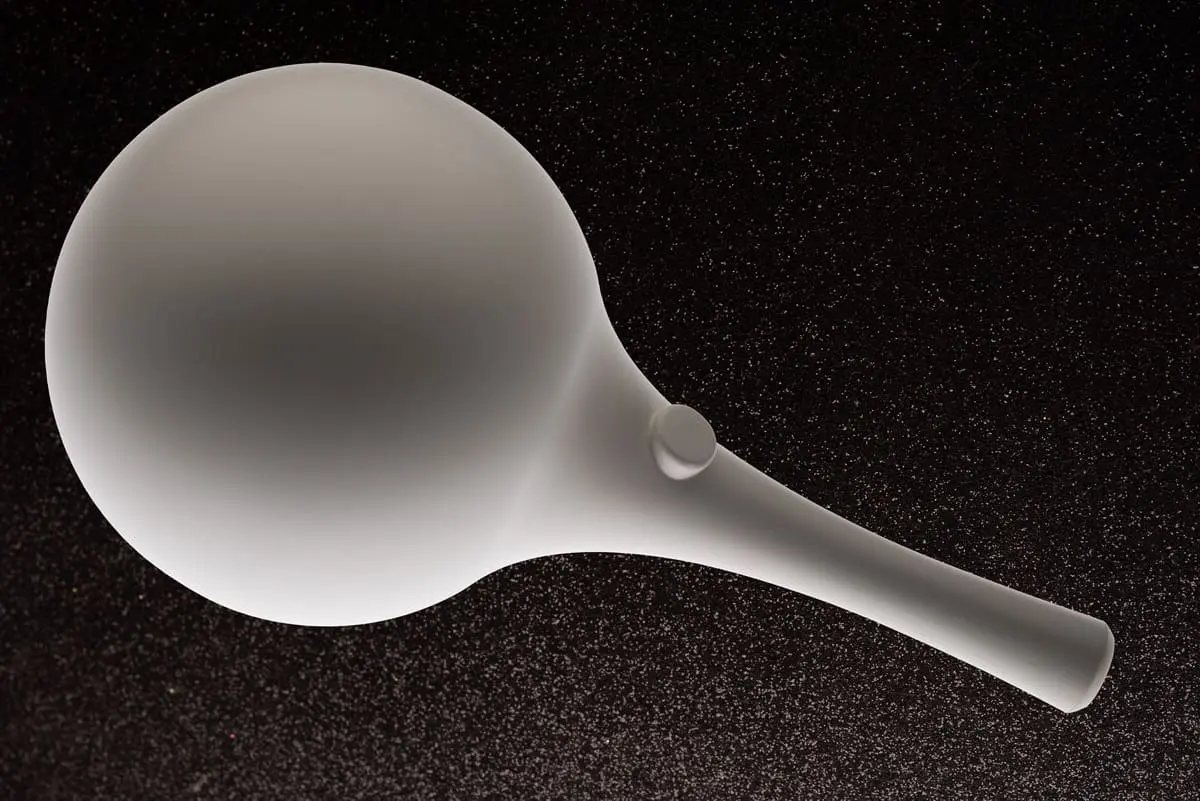
The image displays an object with a minimalist and futuristic design, photographed in close-up against a dark, speckled background that evokes the aesthetic of deep space or stardust. The object is a continuous, matte white plastic form, consisting of a large spherical section that progressively tapers into a cylindrical handle, vaguely resembling the silhouette of a table tennis paddle or a hand mirror. At the junction between the sphere and the handle, there is a small circular relief, similar to an activation button. The surface is perfectly smooth and devoid of visible seams, suggesting production via 3D printing or advanced molding. The soft lighting emphasizes the purity of the lines and the softness of the curves, placing the object within a context of speculative or biotechnological design.
**EMO SPACE:** This tool highlights the power of use and gesture design in microgravity space and works intuitively like a musical shaker for preparing and cooking ingredients that are placed inside: by shaking it, the food is mixed and heated and when it is ready it can be consumed in the half-sphere shaped bowl that makes up the top of the object. Authors: K. Chen, K. Gao, P. Shan, Y. Hua, A. Zheng

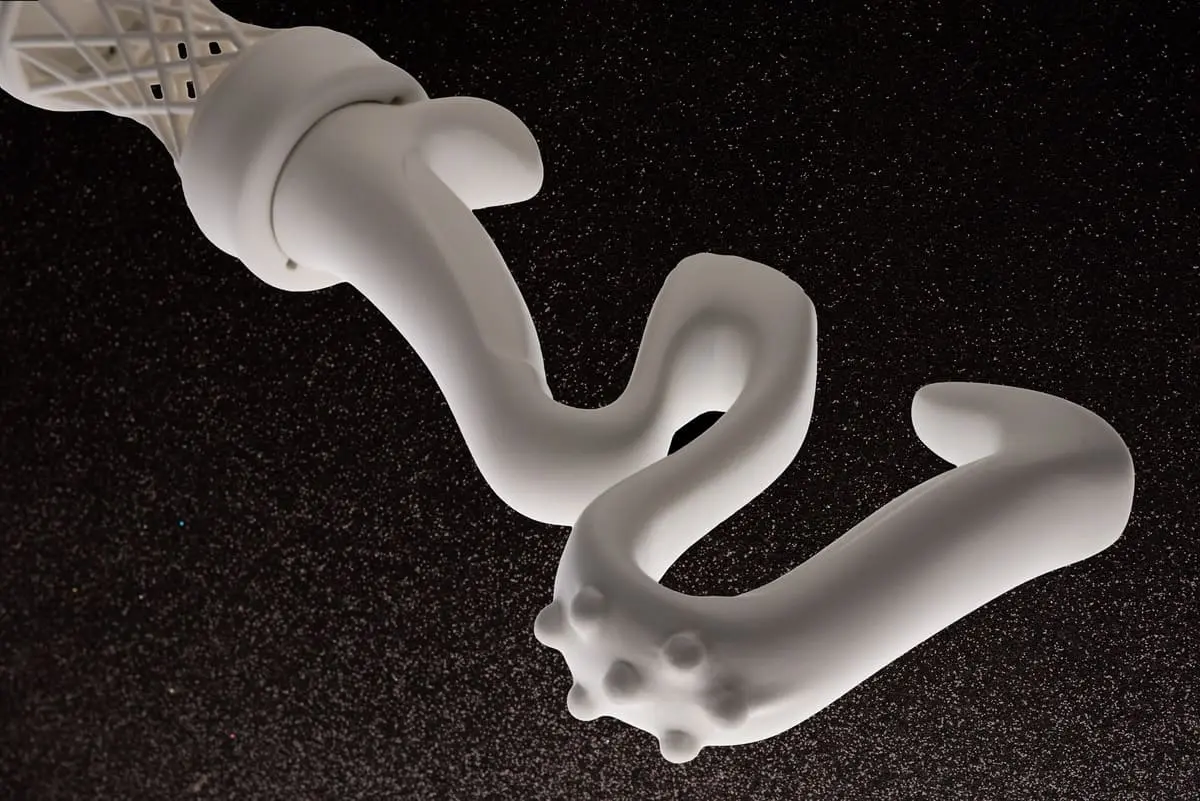
Exerity, a microgravity fitness tool that exploits the extreme freedom of postures assumed by the body with adaptable handles for both hands and feet. Pare is inspired by the gesture of peeling fruit that brings us back to earth as we enjoy a space fruit made with edible packaging to eliminate waste.

The image is an artistic and speculative photograph exploring the design of functional objects for microgravity environments, blending biological aesthetics with engineering precision. In the foreground, a matte white object stands out, suspended against a dark, speckled background that evokes stardust. Its shape is fluid and organic, winding in a double "S" curve, terminating in a section rich with small spherical reliefs, similar to a tactile tip or a biological suction cup. At the opposite end, the object is connected to a cylindrical structure and a hexagonal honeycomb lattice, typical of generative design. The soft lighting emphasizes the softness of the curves and the complexity of the textures, suggesting an advanced biotechnology prototype or a mobility accessory for space, designed to adhere or interact in zero gravity.
**EXERITY:** An innovative in-space fitness system aboard the International Space Station that adds variety to use and exercise, activating muscles in a different way than the machines astronauts are used to, mainly TVIS, CEVIS and RED dedicated to the lower and upper limbs. Exerity integrates muscle strengthening and stretching exercises, stimulating the lymphatic system and improving circulatory flow through massage, thanks to the raised textures on the surface of the equipment. Authors: C. Castiglione, A. Pezzetti, E. Rossi, F. Saffari, G. Vergani

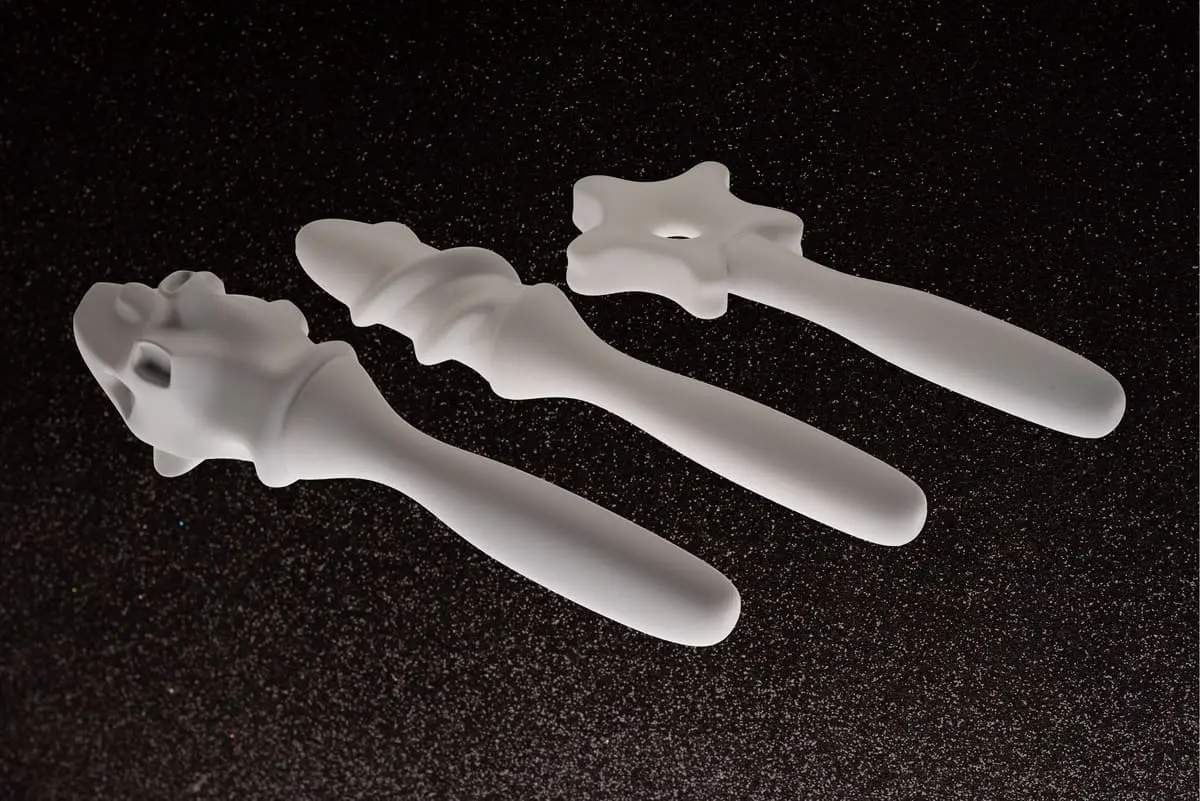
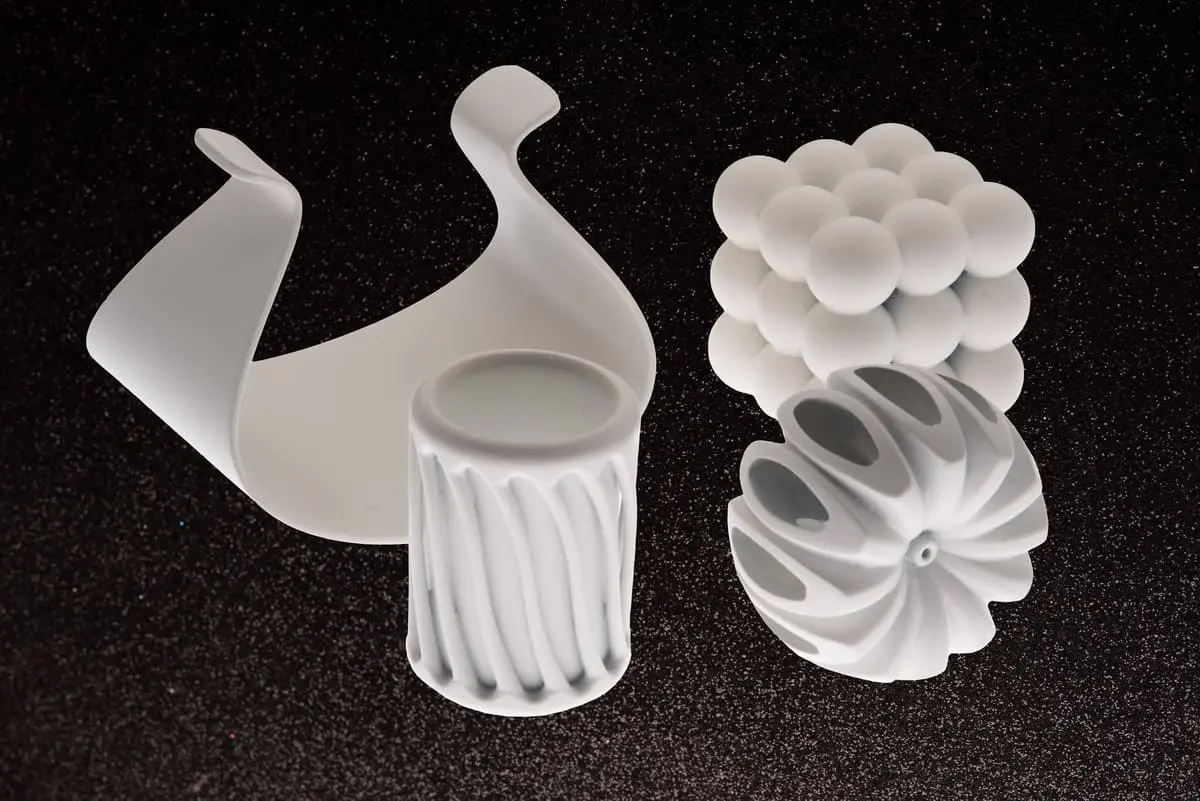
Rethinking Eating consists of several elements: 3D-printed structural paste solids containing nutrient-rich protein sauces inside, and instruments that take shape by dialoguing with the solids and liquids in microgravity, to offer space tourists an extraordinary food and wine tasting experience inside a space hotel dedicated to well-being.

The image displays an object with an industrial and futuristic design, photographed with an aesthetic that evokes space exploration or cutting-edge technology. The object is a translucent white hemispherical shell, characterized by wide, symmetrical elliptical openings that lighten its structure. A thin cylindrical stem is attached to the center of the dome, giving the whole piece a shape reminiscent of a stylized kitchen utensil or a component of a technological interface. The surface has a slightly matte texture that softly diffuses light. The grainy black background, similar to cosmic dust or volcanic sand, creates a strong visual contrast, isolating the object and making it appear like a technological artifact suspended in a vacuum.
The image features three objects with a speculative and minimalist design, arranged diagonally against a dark, grainy background that evokes cosmic dust or a nighttime planetary surface. The three objects, made of a matte white material with a silky finish, share a cylindrical handle similar to that of a toothbrush or a surgical instrument, but terminate in heads with different symbolic and organic shapes. From left to right, we find: a head that stylishly reproduces a human face, one with a spiral or screw-like shape, and the last one ending in a star silhouette with a hole in the center. The purity of the white and the precision of the shapes suggest production via advanced 3D printing. The context appears to be futuristic product design, exploring the interaction between daily tools, identity, and symbolism in extraterrestrial living scenarios.
The image presents an anthology of parametric and futuristic design objects, photographed in a composition that highlights their diverse formal and material qualities. Against a grainy black background reminiscent of lunar regolith, four matte white objects are arranged, each representing a different approach to 3D modeling. In the upper left, there is a fluid, ribbon-like form that coils upon itself; in the center, a cylinder characterized by a complex pattern of wavy vertical grooves. To the right stands a molecular structure composed of numerous perfectly aggregated spheres, while at the bottom, a hemispherical volume with a radial texture of elliptical holes emerges. The top-down and grazing lighting emphasizes the precision of the surfaces and the cleanliness of the design, suggesting a collection of prototypes for technical components or accessories for life in extraterrestrial habitats.
**RETHINKING EATING:** A tasting experience in space requires new tools for taking food and drinking wine that are based on an in-depth study of the behaviour of matter and liquids, as well as gestures that are only possible in the absence of gravity: from the structural form of pasta, which contains nutrient-rich sauces, to the volumes of cutlery and glasses that do not rest and in which wine flows by capillarity, following lines of force to the rim of the goblet. Authors: F. E. Arar, T. Kang, G. Mammoliti, B. Ozcan, G. Rubino

Finally, Send Sens allows the haptic sensation to be recreated through a device worn on the ground and in space by two people who can exchange caresses and hugs, even if they are far apart.

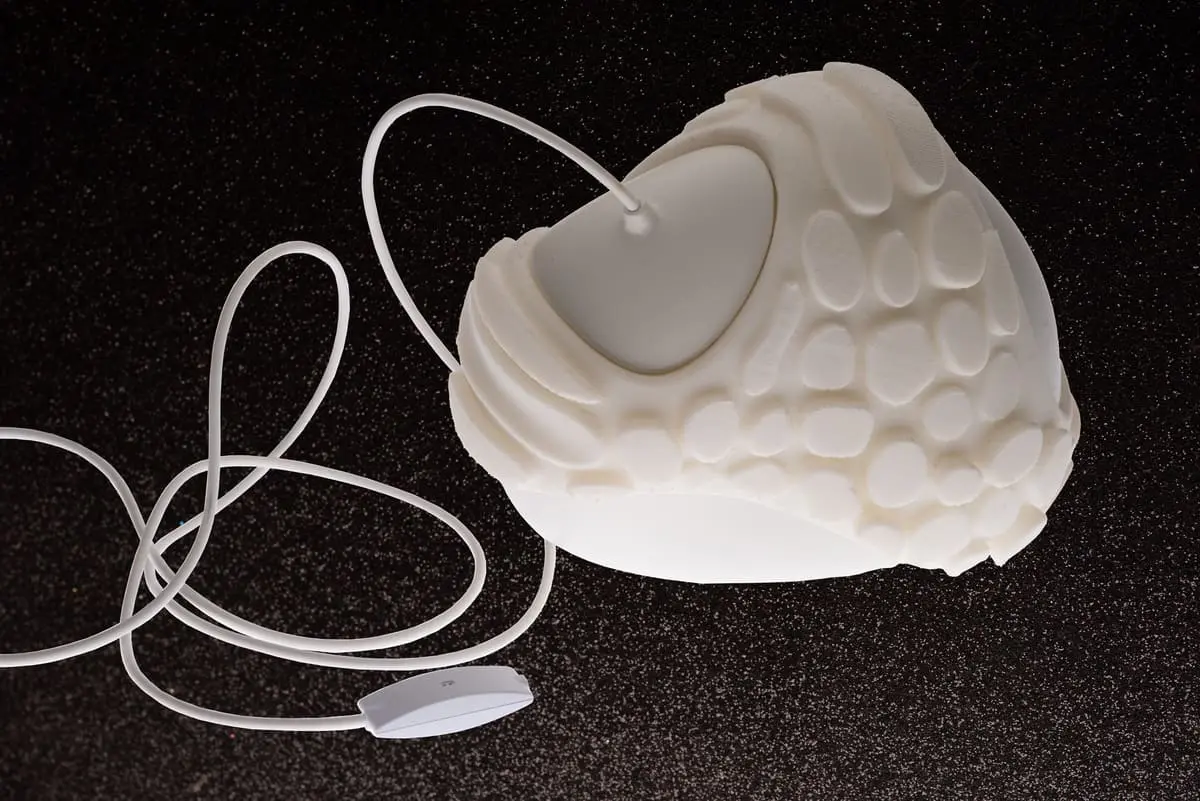
The image captures a technological prototype with an organic and modular design, presented in a photographic setting that evokes space exploration. At the center of the composition is an off-white, asymmetrically hemispherical device. Its surface features a complex pattern of circular and oval reliefs of varying sizes, reminiscent of natural growth or cellular structures. Thin, flexible white cables emerge from the device, ending in a small oval control module, suggesting a wearable system or a sensor for biometric monitoring. The black background, dense with tiny points of light like a star field, emphasizes the futuristic nature of the project, positioning it as a tool designed for life or research in extra-atmospheric environments.
**SEND SENS:** Twin 'soft robots' help to connect people by remotely sending the sensation of physical contact: the object consists of a hard core, charging and transmitting, and a soft part, worn on the hand or around the arm by the astronaut in space and a family member on earth, which lights up by sending a colour code when either party wants to communicate. The soft robotics give the sensation of movement and touch by moving fluids controlled by a CPU. Authors: A. Càceres, E. G. P. Camilla, D. Carlini, L. Iannello, V. Rodriguez Schon

CREDITS
Photos: LAB Image
Models and prototypes: Department of Design
Professors: Annalisa Dominoni and Benedetto Quaquaro
Exhibition curated by: Triennale di Milano

Share on: