Situated Vocabularies

Edited by Virginia Tassinari, Francesca Piredda and Francesco Vergani

Situated Vocabularies. A situated and agonistic conversational platform is a volume that presents a participatory design research project aimed at the co-design of vocabularies of shared meanings, conceived as tools to foster conversations among situated communities and to prompt future-oriented transformative actions. 

The book investigates the power of words as design and political devices, capable of making visible convergences, conflicts, divergences, and nuanced meanings that emerge within complex social contexts, thereby questioning the idea of a neutral and universal language.

Rooted in Hannah Arendt’s definition of democracy and inspired by the vocabulary artifact, the project understands language as an agonistic space of confrontation, negotiation, and collective meaning-making. Its objective is not to impose shared definitions, but to disarticulate and potentially rearticulate different perspectives within a specific context, through collaborative processes involving a plurality of actors and stakeholders. In this sense, Situated Vocabularies takes the form of a conversational platform that makes explicit the interdependencies between subjects, forms of knowledge, and worldviews, while also valuing the tensions and power asymmetries that run through these relationships.
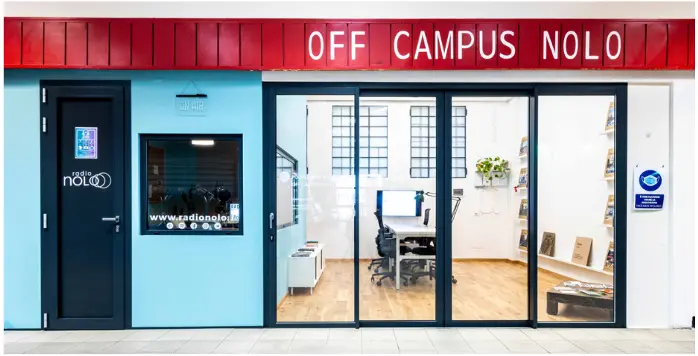
The image shows the exterior facade of the "OFF CAMPUS NOLO" space, a territorial laboratory of the Politecnico di Milano located inside the Municipal Market on Viale Monza, Milan. The structure features a modern, colorful design divided into two functional areas. On the left, a light blue wall houses the Radio NoLo studio, with a dark door and a window showing the indoor microphone setups; an "On Air" sign is visible above the glass. On the right, a large sliding glass door reveals the co-working and office area, featuring wooden floors, white walls, shelves filled with publications, and a workstation with a computer. A red sign with the space's name in large white letters runs across the entire facade.
The original space of Off Campus Nolo back in 2020. Image taken from the essay “Off Campus Nolo: Co-producing Knowledge with Situated Communities” by Francesco Vergani.

The experiments presented in the volume are developed within the urban living labs of Off Campus, an initiative of Politecnico di Milano aimed at making the university’s presence in the city more tangible and at strengthening researchers’ responsibility toward contemporary social challenges. Through case studies carried out in the Nolo neighborhood and in San Vittore prison in Milan, the book explores how design for participation can open up to other perspectives and other possible worlds, connecting urban and institutional spaces that are profoundly different yet radically interconnected. In particular, the work conducted in San Vittore highlights the potential of design to create symbolic and communicative bridges between prison and society, questioning the role of design in the translation of meanings, the construction of agency, and the rethinking of the boundaries between inside and outside.

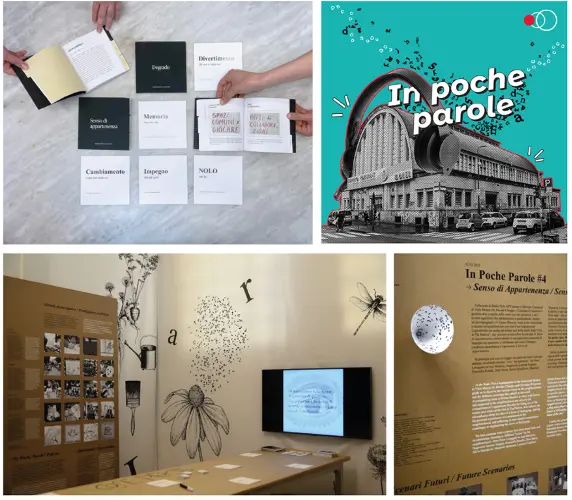
The following is the English description of the collage:  The image is a four-panel collage documenting various phases and components of the "In Poche Parole" (In a Nutshell) participatory project, centered on the NoLo district in Milan.  In the upper-left panel, several small square booklets are spread across a marble surface. Participants' hands are seen flipping through them, revealing handwritten definitions and reflections on key terms such as "Senso di appartenenza" (Sense of belonging), "Cambiamento" (Change), "Memoria" (Memory), and "NOLO."  The upper-right panel features a vibrant graphic with a teal background and red accents. It displays a black-and-white photograph of the Viale Monza Municipal Market topped with a pair of large black headphones and the title "In poche parole," suggesting the project's focus on listening and radio broadcasting.  In the lower-left panel, a corner of an exhibition layout is shown. A white wall features elegant black-and-white botanical illustrations—including a large flower, dragonflies, and gardening tools—alongside a monitor displaying text. To the side, a brown informational panel shows photographs of workshop activities.  Finally, the lower-right panel provides a close-up of a kraft paper board titled "In Poche Parole #4" followed by the theme "Senso di Appartenenza." It includes bilingual text in Italian and English describing the project's narrative journey. A small circular cutout in the panel reveals an internal graphic detail, adding tactile depth to the display.  The entire collage communicates a design approach that merges social research, urban storytelling, and active community participation.
Narrative artifacts of the Nolo Situated Vocabulary: from the top left, the booklets; to the right, the logo of the podcast In Poche Parole; below, details of the exhibition Situated Vocabularies – Re-framing Participation with Fragile Communities at Off Campus Nolo. Image taken from the essay “Narrating Collective Meanings through Tangible Artifacts and Immersive Spatial Experiences” by Ambra Borin.

As a whole, Situated Vocabularies offers a critical reflection on the role of design as a situated, relational, and responsible practice, capable of operating not only through objects and services, but also through words, narratives, and meaning-making tools. The volume addresses designers, researchers, and students interested in participatory design, social research, and change-oriented design practices, providing a theoretical and methodological contribution on how language can become a key lever for imagining and building shared futures.

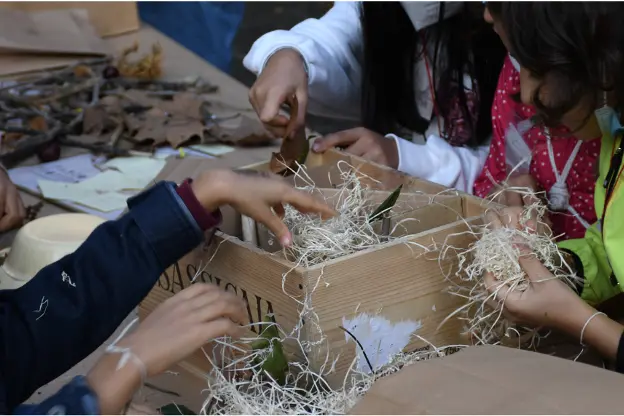
These photos showcase the social and workshop side of the projects. One collage summarizes the "In Poche Parole" community initiative, while the final photo depicts a hands-on workshop. Participants are gathered around a table, interacting with a wooden crate filled with straw, dried leaves, and natural materials, suggesting a collaborative activity focused on nature, sustainability, or tactile exploration.
Participants co-constructing the bugs’ hotels. Image taken from the essay “Gaia’s Club: Embodying Situated Vocabulary in Public Spaces through Transmedia Storytelling for Kids” by Valentina Ferreri.
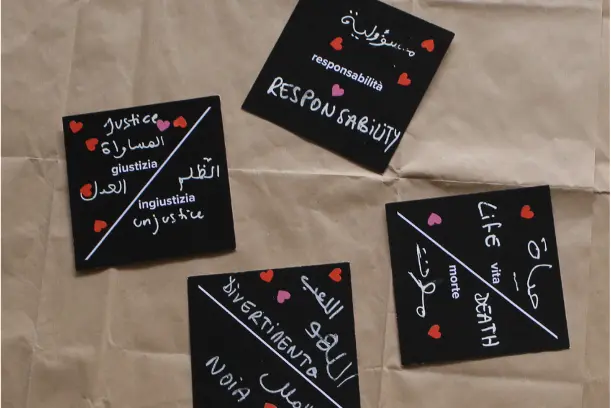
The image shows four square black tiles arranged on a sand-colored kraft paper background, part of the "In Poche Parole" participatory project. Each tile explores universal concepts through handwritten text in different languages, including Italian, English, and Arabic, decorated with small red and pink hearts. The terms analyzed include contrasts such as justice and injustice, life and death, fun and boredom, as well as the value of responsibility. This component of the project highlights multicultural dialogue and the use of language as a bridge between the different communities living in the neighborhood.
The words selected by the inmates participating in the San Vittore Situated Vocabulary. Image taken from the essay “Off Campus San Vittore: Bridging Prison and Society” by Francesca Piredda.

Share on: